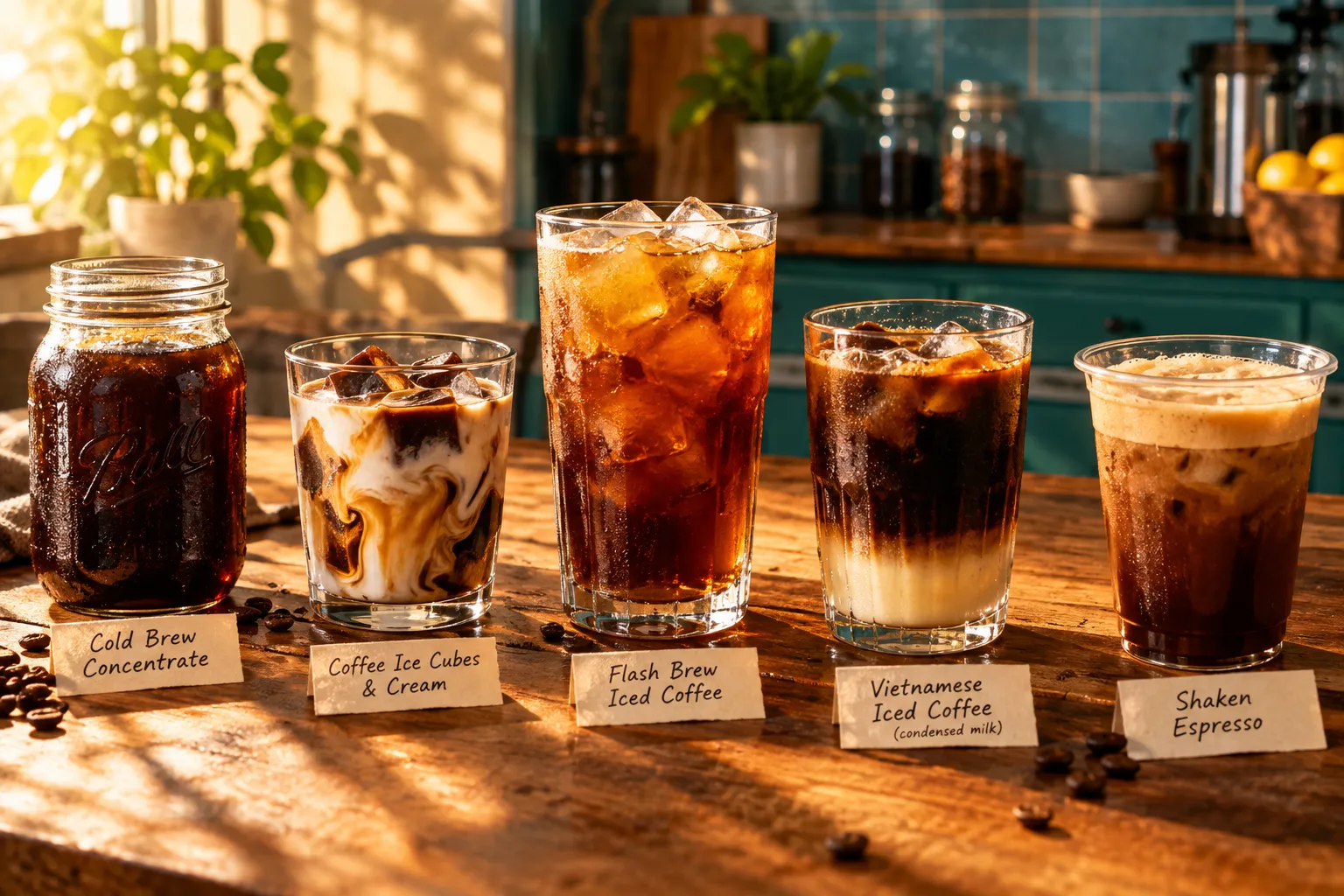
The best iced coffee hacks at home are: brew coffee directly onto ice (flash brew), freeze leftover coffee into ice cubes, make a simple cold brew concentrate, use simple syrup instead of granulated sugar, and choose a medium-to-dark roast bean with low acidity. These five methods solve the most common problems, diluted coffee, bitter taste, and wasted time, without any expensive equipment.
What Is the Best Way to Make Iced Coffee at Home
The best all-around method is flash brewing: you brew a double-strength batch of hot coffee directly over a glass full of ice. The ice chills the coffee instantly while the extra-strong brew compensates for the dilution from melting ice. You get a fresh, bright-tasting iced coffee in about five minutes with no waiting.
Here is how to do it:
- Fill a glass or mason jar with ice (about half full).
- Brew your coffee at double strength, use twice the normal amount of grounds for the same volume of water.
- Pour the hot brew directly over the ice.
- Stir for ten seconds and add milk or sweetener if you want.
Why it works: Hot coffee extracts flavor compounds fully, while the ice locks in freshness immediately. You avoid the flat, stale taste that comes from letting hot coffee cool slowly at room temperature.
For a different style, check out this iced caramel latte recipe that uses a similar flash-brew base.
How Do You Keep Iced Coffee from Getting Diluted
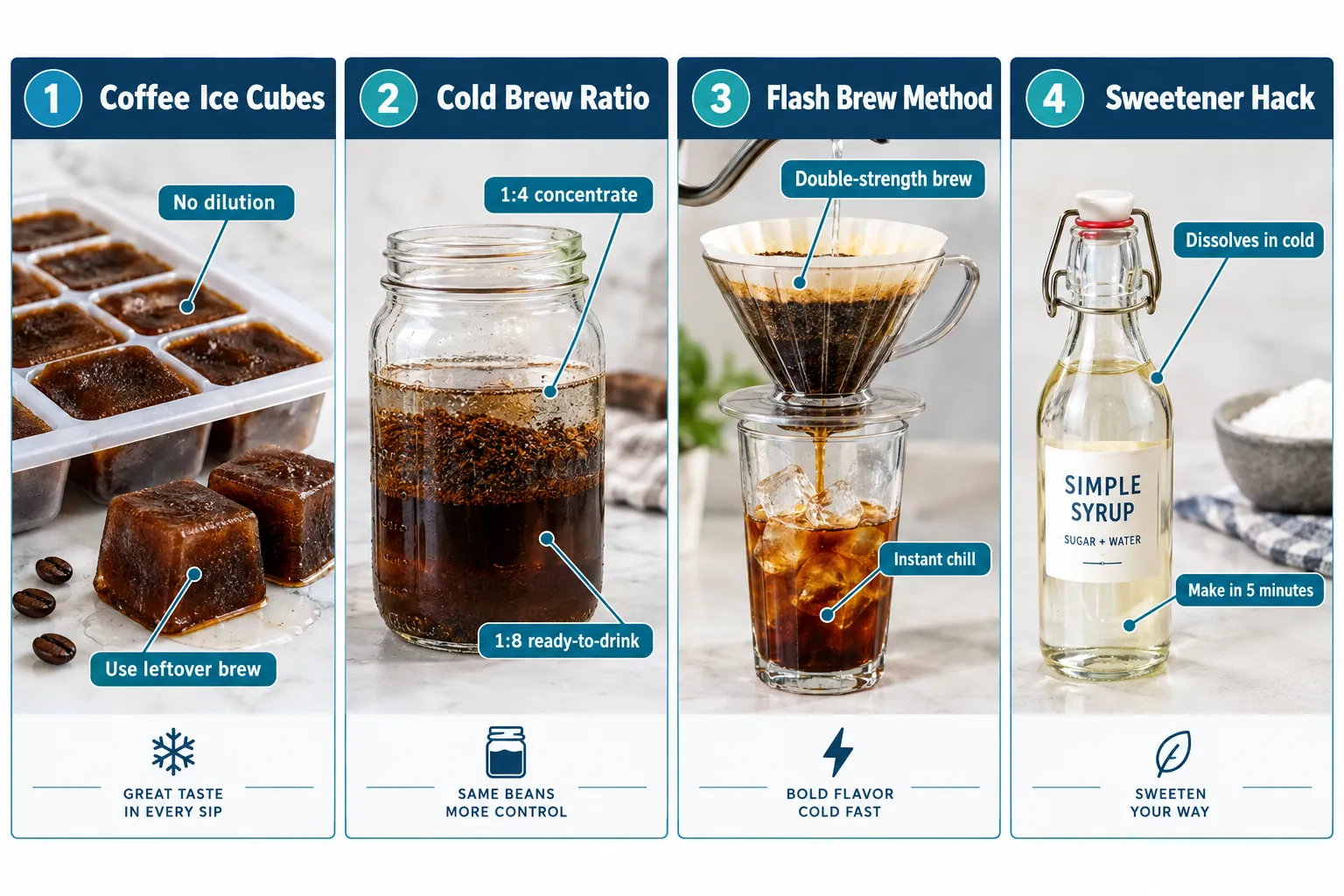
The single best fix for watery iced coffee is coffee ice cubes. Freeze leftover brewed coffee in a standard ice cube tray, then use those cubes instead of water ice. As they melt, they add more coffee flavor instead of diluting it.
Two more options if you do not want to freeze coffee:
- Use less ice and pre-chill your glass in the freezer for 10 minutes before pouring.
- Brew at double strength so even if regular ice melts, the final drink stays balanced.
Common mistake: people use a full glass of regular ice with normal-strength coffee. The result is always watered down. Either strengthen the brew or switch to coffee ice cubes.
Cold Brew vs Iced Coffee: What Is the Actual Difference
Cold brew and iced coffee are not the same drink. Iced coffee is hot-brewed coffee that has been cooled and poured over ice. Cold brew is made by steeping coarse coffee grounds in cold or room-temperature water for 12 to 24 hours, with no heat involved at all.
| Feature | Iced Coffee | Cold Brew |
|---|---|---|
| Brew time | 5 minutes | 12 to 24 hours |
| Flavor | Bright, slightly acidic | Smooth, low acid, sweeter |
| Equipment needed | Any coffee maker | Mason jar + strainer |
| Caffeine level | Standard | Higher (concentrate) |
| Best for | Quick prep | Batch prep, sensitive stomachs |
Cold brew is naturally lower in acidity because heat is never used. If regular coffee upsets your stomach, cold brew is worth trying. For a deeper look at this, see acid in cold brew vs regular coffee.
Can You Use a Regular Coffee Maker for Iced Coffee
Yes, a standard drip coffee maker works perfectly for iced coffee. You do not need special equipment. The key is to brew at double strength so the coffee holds up when poured over ice.
Steps for a drip machine:
- Use your normal amount of water.
- Double the amount of coffee grounds.
- Place a glass or pitcher of ice under the carafe (if your machine allows) or pour directly over ice immediately after brewing.
- Add milk, cream, or sweetener to taste.
If you want to explore other affordable brewing tools, a French press or manual grinder also works well for cold brew prep.
What Is the Cheapest Way to Make Iced Coffee at Home
Mason jar cold brew is the cheapest method. You need coarse ground coffee, cold water, a mason jar, and a fine mesh strainer or paper filter. That is it. No machine, no pods, no special gear.
Basic mason jar cold brew:
- Add 1 cup of coarse ground coffee to a 32 oz mason jar.
- Pour in 4 cups of cold water (1:4 ratio for concentrate).
- Stir, cover, and place in the fridge for 12 to 24 hours.
- Strain through a fine mesh strainer or paper filter.
- Dilute with water or milk before drinking (1 part concentrate to 1 part liquid).
One batch makes roughly 4 to 6 servings. At current grocery prices, that works out to well under a dollar per serving compared to $5 to $7 at a coffeehouse. If you are unsure what filter to use, this guide on what you can use as a coffee filter covers your options.
How to Make Iced Coffee Taste Like Starbucks at Home
The coffeehouse flavor comes from three things: a medium-to-dark roast, simple syrup (not granulated sugar), and a milk-to-coffee ratio that is heavier on the coffee. Most homemade versions taste weak or flat because the coffee is too diluted or the sweetener does not dissolve properly.
The three fixes:
- Simple syrup: Mix equal parts sugar and water in a small saucepan, heat until the sugar dissolves, then cool. It blends perfectly into cold drinks. Granulated sugar sinks to the bottom and never fully mixes.
- Roast choice: Starbucks uses medium-to-dark roasts with chocolate and caramel notes. A Colombian or Brazilian medium-dark roast gets you closest.
- Ratio: Use more coffee than you think you need. A good starting point is 2 tablespoons of ground coffee per 6 oz of water, then adjust from there.
For a specific recipe that nails this balance, see how to make an iced hazelnut latte.
Best Coffee Beans for Iced Coffee
Medium-to-dark roast beans with natural sweetness and low acidity work best for iced coffee. Light roasts can taste sour or thin when cold. Look for tasting notes like chocolate, caramel, brown sugar, or nuts.
Top bean types to look for:
- Brazilian Santos: Low acidity, nutty, smooth. Great for cold brew.
- Colombian Supremo: Balanced, mild fruit, caramel finish. Works for both flash brew and cold brew.
- Sumatra Mandheling: Earthy, full-bodied, very low acid. Good for strong cold brew concentrate.
Grind matters too. For cold brew, use a coarse grind (similar to raw sugar texture). For flash brew, use a medium grind. A consistent grind produces cleaner flavor. If you need a grinder, the Bodum electric coffee grinder is a solid entry-level option.
For a full breakdown of bean types and what they taste like, see everything you need to know about coffee beans.
Why Does My Homemade Iced Coffee Taste Bitter
Bitter homemade iced coffee is almost always caused by over-extraction. This happens when water is too hot, the grind is too fine, or the brew time is too long. All three pull out the harsh, bitter compounds from the grounds.
Quick fixes:
- For hot-brew methods: use water between 195 and 205 degrees Fahrenheit (just off the boil). Water that is too hot over-extracts in seconds.
- For cold brew: do not steep longer than 24 hours. After that, bitterness increases noticeably.
- Check your grind: if it is too fine for cold brew, switch to a coarser setting.
- Old or stale beans also taste bitter. Use beans within four weeks of the roast date.
A secondary cause is using robusta beans or low-quality pre-ground coffee. Robusta has nearly double the caffeine of arabica but a much harsher, more bitter taste. Switching to 100% arabica makes a clear difference.
Iced Coffee Hacks for Busy Mornings
The most practical hack for busy mornings is making your iced coffee the night before. Cold brew concentrate stores in the fridge for up to two weeks, so you can make one large batch on Sunday and have iced coffee every morning without any prep.
Night-before routine:
- Make a batch of cold brew concentrate on Sunday (or any evening).
- Store in a sealed mason jar in the fridge.
- Each morning, pour 4 oz of concentrate over ice and add 4 oz of milk or water. Done in 30 seconds.
Other time-saving hacks:
- Pre-make a batch of simple syrup and store it in a squeeze bottle in the fridge. It keeps for about a month.
- Freeze coffee ice cubes in bulk once a week so they are always ready.
- Use a programmable coffee maker to auto-brew a double-strength batch while you sleep.
How Long Does Homemade Iced Coffee Last in the Fridge
Cold brew concentrate lasts up to two weeks in the fridge when stored in a sealed airtight container. Iced coffee that has already been diluted with water or milk lasts only one to two days before the flavor degrades and the milk spoils.
Storage rules:
- Store cold brew concentrate only (do not add milk until you are ready to drink).
- Use a glass jar with a tight lid, plastic can absorb odors.
- Label the jar with the date you made it.
- If the coffee smells sour or flat, discard it regardless of the date.
Flash-brewed iced coffee (hot coffee poured over ice) is best consumed the same day. It loses brightness and can taste stale after 24 hours in the fridge.
What Is the Right Coffee to Water Ratio for Iced Coffee
The ratio depends on the method. For cold brew concentrate, use 1 part coffee to 4 parts water by weight or volume. For ready-to-drink cold brew, use 1 part coffee to 8 parts water. For flash brew (hot over ice), use a 1:8 ratio of grounds to water but brew at double strength, meaning you use the same amount of water as usual but double the grounds.
| Method | Coffee | Water | Notes |
|---|---|---|---|
| Cold brew concentrate | 1 cup | 4 cups | Dilute before drinking |
| Cold brew ready-to-drink | 1 cup | 8 cups | Drink as-is |
| Flash brew | 2 tbsp per 6 oz | 6 oz | Pour directly over ice |
| Drip (iced) | Double normal dose | Normal amount | Brew over ice |
For more detail on measuring coffee by beans, grams, and tablespoons, see how many coffee beans per cup of coffee.
Do You Need Special Equipment for Iced Coffee at Home
No. You can make excellent iced coffee at home with a mason jar, a fine mesh strainer, and whatever coffee maker you already own. Special equipment like a cold brew tower or a Japanese iced coffee dripper can improve consistency, but they are not required.
What you actually need:
- A mason jar or any large container with a lid
- A fine mesh strainer or paper coffee filter
- A coffee maker (any type), or no machine at all for cold brew
- Ice cube trays
What is optional but helpful:
- A burr grinder for consistent grind size (a blade grinder works but produces uneven results)
- A kitchen scale for accurate ratios
- A cold brew pitcher with a built-in filter for easier straining
If you want to invest in a grinder, the best coffee grinder guide covers options at every price point.
Frequently Asked Questions
Can I make iced coffee with instant coffee?
Yes. Dissolve two teaspoons of instant coffee in a small amount of hot water first, then pour over ice and add cold water or milk. It will not taste as rich as brewed coffee, but it works in a pinch.
What milk works best for iced coffee?
Whole milk gives the creamiest result. Oat milk is the most popular non-dairy option because it has a naturally sweet, neutral flavor that does not overpower the coffee. Avoid low-fat milk if you want a rich texture.
Can you make iced coffee with a French press?
Yes. Brew at double strength, let it cool for five minutes, then press and pour over ice. A French press also works well for cold brew, steep the grounds in cold water in the fridge for 12 to 24 hours, then press and strain.
Why does my cold brew taste weak?
Either the ratio is off (not enough coffee), the steep time was too short, or the grind was too coarse. Try increasing the coffee amount slightly, extending the steep time to 18 to 24 hours, or using a slightly finer (but still coarse) grind.
Is iced coffee stronger than hot coffee?
It depends on how it is made. Cold brew concentrate is significantly stronger than a standard cup of hot coffee. Flash-brewed iced coffee made at double strength is also stronger than a regular cup. Standard iced coffee (hot coffee cooled and poured over ice) is usually weaker because the ice dilutes it.
Can I add protein powder to iced coffee?
Yes. Blend iced coffee with a scoop of vanilla or chocolate protein powder for a quick breakfast drink. It mixes better when blended rather than stirred. For recipe ideas, see 7 coffee protein smoothies.
What is the best sweetener for iced coffee?
Simple syrup is the best choice because it dissolves completely in cold liquid. Honey also works but has a distinct flavor. Flavored syrups (vanilla, hazelnut, caramel) are easy to make at home with the same simple syrup method, just add the flavoring while the syrup is still warm.
Does iced coffee have more caffeine than hot coffee?
Not inherently. Caffeine content depends on the coffee type, grind, ratio, and brew time. Cold brew concentrate does have more caffeine per ounce than a standard hot brew, but once diluted to a normal serving size, the difference is smaller. For a full breakdown, see the table of caffeine contents in a cup of coffee.
Can I use flavored coffee beans for iced coffee?
Yes, but use them sparingly. Flavored beans can taste artificial when cold. A better approach is to use unflavored beans and add a homemade flavored syrup so you control the intensity.
How do I stop my iced coffee from being too acidic?
Switch to cold brew. Because no heat is used, cold brew extracts fewer acidic compounds and tastes naturally smoother. Choosing low-acid beans (Brazilian, Sumatran) also helps significantly.
Conclusion
The 5 iced coffee hacks at home covered in this guide solve the real problems: dilution, bitterness, weak flavor, wasted time, and high cost. Here is a quick action plan:
- Start with coffee ice cubes, freeze your next leftover pot and use those cubes all week.
- Try flash brew once, it takes five minutes and produces a noticeably better drink than letting hot coffee cool.
- Make a mason jar cold brew batch on a Sunday evening. You will have ready-to-go iced coffee for the entire week.
- Switch to simple syrup if your iced coffee never tastes sweet enough, granulated sugar simply does not dissolve in cold drinks.
- Check your beans and grind if bitterness is the issue. A medium-to-dark arabica roast with a coarse-to-medium grind covers most problems at once.