
You should descale a coffee machine every 1-3 months depending on water hardness and usage frequency. If you use hard water or brew multiple cups daily, descale monthly. With soft water and occasional use, every three months works fine. Regular descaling prevents mineral buildup that damages your machine and ruins coffee taste.
Key Takeaways
- Descale every 1-3 months based on water hardness and how often you brew coffee
- Hard water areas need monthly descaling; soft water areas can wait 3 months
- Daily heavy users should descale more often than occasional weekend brewers
- Mineral buildup reduces heating efficiency and clogs internal pipes
- Most machines have descaling indicators that alert you when it’s time
- Skipping descaling voids warranties and shortens machine lifespan by years
- Use manufacturer-approved descaling solutions or citric acid alternatives
- The process takes 30-45 minutes including rinse cycles
- Signs you need descaling include slow brewing, weird taste, and loud noises
- Pod machines and espresso makers need different descaling schedules
What Does Descaling a Coffee Machine Actually Mean
Descaling removes mineral deposits (mainly calcium and magnesium) that build up inside your coffee machine from tap water. These minerals form a chalky white substance called limescale that coats heating elements, clogs pipes, and blocks water flow.
Every time you brew coffee, tiny amounts of minerals get left behind. Over weeks and months, this buildup becomes thick enough to cause real problems. The descaling process uses acidic solutions to dissolve these deposits and flush them out.
Why it matters: Limescale acts like insulation around heating elements, forcing your machine to work harder and use more energy. It also restricts water flow through narrow passages, leading to weaker coffee and longer brew times.
Think of it like plaque on teeth. A little buildup seems harmless, but left unchecked, it causes serious damage. Regular descaling keeps your machine running efficiently and your coffee tasting fresh.
How Often Should You Descale a Coffee Machine Based on Water Hardness
Water hardness is the biggest factor in determining your descaling schedule. Hard water contains high mineral content that accelerates limescale buildup.
Descaling frequency by water type:
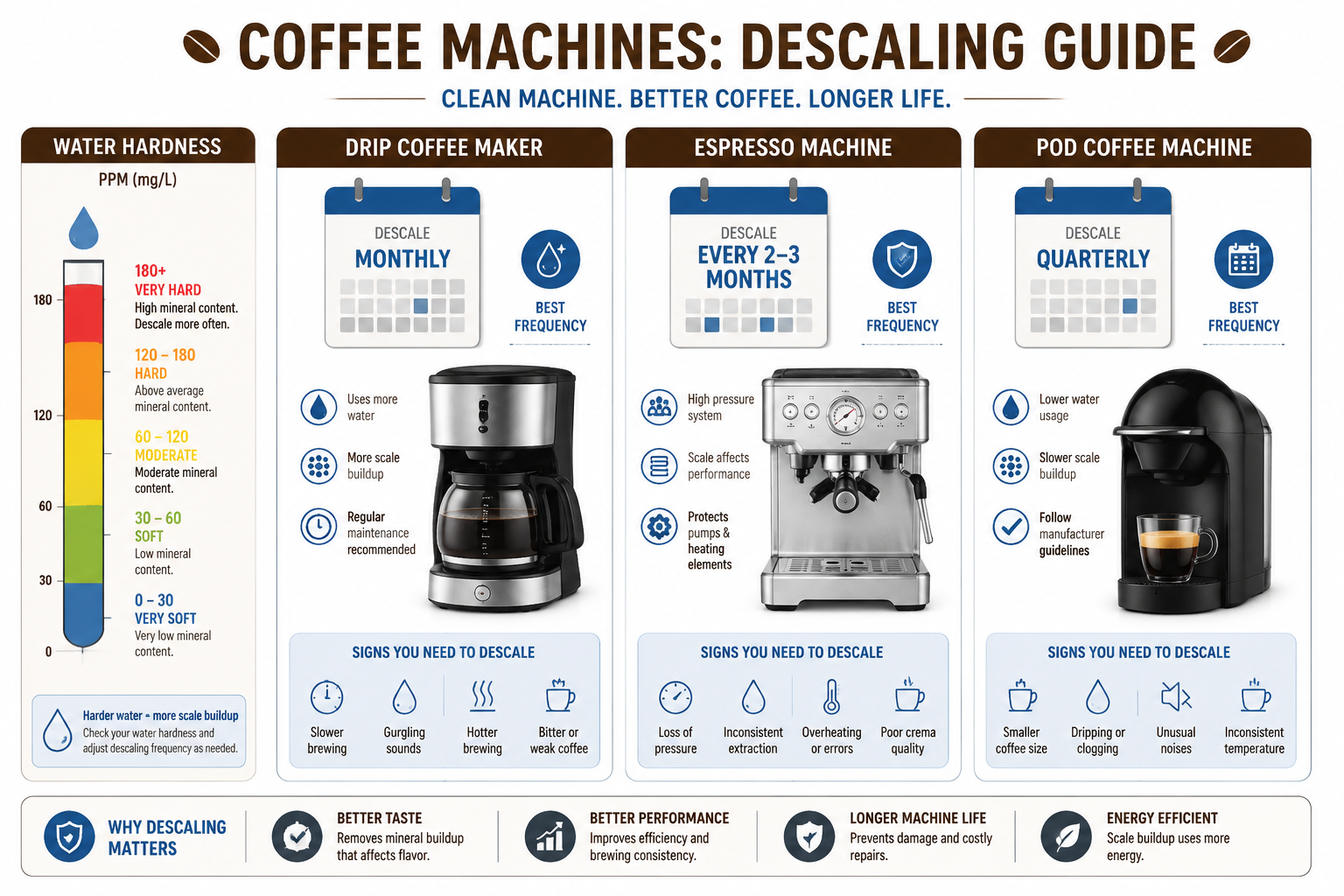
- Very hard water (above 180 ppm): Every 4-6 weeks
- Hard water (120-180 ppm): Every 2 months
- Moderately hard water (60-120 ppm): Every 2-3 months
- Soft water (below 60 ppm): Every 3-4 months
You can test your water hardness with inexpensive test strips from hardware stores or check your local water utility website for area reports. Many bean to cup coffee machines have built-in water hardness settings that adjust descaling reminders automatically.
Real-world example: If you live in Phoenix or Las Vegas (very hard water areas), plan to descale monthly. In Seattle or Portland (soft water), every three months works fine.
Common mistake: Assuming bottled or filtered water eliminates descaling needs. While these reduce minerals, they don’t eliminate them completely. You still need regular descaling, just less frequently.
How Usage Frequency Changes Your Descaling Schedule
How often you brew coffee directly impacts how quickly minerals accumulate. More brewing cycles mean more mineral deposits.
Usage-based guidelines:
- Heavy use (5+ cups daily): Descale every 4-6 weeks regardless of water hardness
- Moderate use (2-4 cups daily): Follow standard water hardness schedule
- Light use (occasional weekend brewing): Can extend schedule by 2-4 weeks
- Commercial/office settings: Descale monthly minimum, possibly bi-weekly
For pod coffee machines with milk frothers, the milk system needs separate cleaning, but the water system follows the same descaling rules.
Decision rule: If you brew more than 30 cups per month with hard water, switch to a monthly descaling schedule. The extra maintenance prevents expensive repairs later.
Office machines serving 10-20 people need professional-grade descaling products and more frequent service. Don’t treat these the same as home machines.
Signs Your Coffee Machine Needs Descaling Right Now
Your machine will tell you when limescale becomes a problem. Watch for these warning signs between scheduled descaling sessions.
Immediate descaling indicators:
- Brew time increases by 50% or more
- Coffee tastes bitter, metallic, or just “off”
- Water flow becomes weak or sputtering
- Machine makes loud gurgling or hissing noises
- Visible white flakes or residue in brewed coffee
- Steam wand (on espresso machines) produces weak steam
- Machine displays descaling warning light
- Water leaks from unusual places
If you notice two or more of these signs, descale immediately even if you just did it recently. Severe buildup can damage internal components permanently.
Edge case: Machines that sit unused for weeks can develop stubborn deposits as water evaporates and leaves concentrated minerals behind. Always descale before storing a machine long-term and after bringing it back into service.
For cappuccino machines, pay special attention to steam wand performance since milk residue combined with limescale creates extra problems.
Step-by-Step: How to Descale Your Coffee Machine Properly
The descaling process takes 30-45 minutes and requires minimal effort. Follow these steps for thorough cleaning.
Complete descaling procedure:
- Empty and clean – Remove all water from reservoir, discard any coffee grounds, and remove water filter if present
- Mix descaling solution – Follow product instructions (typically 1 part descaler to 4 parts water) or use 2 tablespoons citric acid per liter of water
- Fill reservoir – Pour descaling solution into water tank up to max fill line
- Run brew cycle – Start brewing without coffee, letting solution run through entire system
- Let it sit – Pause halfway through and let solution sit in machine for 15-20 minutes
- Complete cycle – Finish running all solution through the machine
- Rinse thoroughly – Fill reservoir with fresh water and run 2-3 complete brew cycles to flush out all descaler
- Clean external parts – Wipe down drip tray, brew group, and exterior surfaces
- Replace filter – Put water filter back in if you removed one
For espresso machines: Also run descaling solution through the steam wand and group head. Backflush if your machine supports it.
For pod machines: Follow the same steps but run the largest cup size setting for each cycle.
Never skip the rinse cycles. Leftover descaling solution will make your next coffee taste terrible and could be harmful to drink.
What Descaling Products Work Best for Coffee Machines
You have several options for descaling solutions, each with different strengths and costs.
Descaling product comparison:
Manufacturer-branded descalers:
- Designed specifically for your machine model
- Most expensive option ($15-25 per descaling)
- Required to maintain warranty on many machines
- Pre-measured for convenience
Universal descaling solutions:
- Work with all coffee machine types
- Mid-range price ($8-15 per descaling)
- Widely available at stores and online
- Good balance of cost and effectiveness
Citric acid powder:
- Natural, food-safe option
- Cheapest choice ($0.50-1 per descaling)
- Requires measuring (2-3 tablespoons per liter)
- Works as well as commercial products
White vinegar:
- Not recommended despite being cheap
- Strong smell lingers after rinsing
- Can damage rubber seals in some machines
- Voids warranties on many brands
Smart recommendation: Use manufacturer-branded descaler for the first year to protect your warranty, then switch to citric acid to save money. Mix 2 tablespoons of food-grade citric acid powder with 1 liter of water for an effective, affordable solution.
Avoid “natural” descalers with unknown ingredients. Stick with proven options that won’t damage internal components or leave harmful residues.
How Descaling Frequency Differs by Coffee Machine Type
Different machine designs accumulate limescale at different rates and in different locations.
Machine-specific descaling schedules:
Drip coffee makers:
- Descale every 1-2 months with hard water
- Simple internal design makes descaling easy
- Focus on water reservoir and heating plate
Espresso machines:
- Descale every 2-3 months (more critical due to high pressure)
- Boiler and group head need special attention
- Steam wand requires separate cleaning
- Backflushing helps between descaling sessions
Pod/capsule machines:
- Descale every 3 months or after 300 capsules
- Built-in descaling programs simplify process
- Needle cleaning needed separately from descaling
Bean-to-cup automatic machines:
- Descale every 2-3 months or per machine indicator
- Most complex internal systems
- Follow manufacturer schedule exactly
- Some models auto-detect when descaling needed
French press/manual brewers:
- No descaling needed (no heating elements)
- Regular washing prevents coffee oil buildup
For eco-friendly coffee machines, check if descaling solutions are compatible with special materials or coatings.
Choose based on this logic: If your machine has a boiler or pressurized system (espresso, automatic), descale more frequently than simple drip machines. Pressure forces minerals into tighter spaces where they cause more damage.
What Happens If You Never Descale Your Coffee Machine
Skipping descaling has serious consequences that get worse over time. The damage isn’t immediately obvious but accumulates with each brew cycle.
Short-term problems (2-6 months without descaling):
- Coffee tastes increasingly bitter or weak
- Brew time doubles or triples
- Machine uses 20-30% more electricity
- Water temperature drops below optimal brewing range
Medium-term damage (6-12 months):
- Internal pipes partially clog, restricting flow
- Heating element efficiency drops by 50% or more
- Pump works harder, wearing out faster
- Visible limescale in water reservoir and drip tray
Long-term failure (1+ years):
- Complete pipe blockages stop water flow
- Heating element burns out from overwork
- Pump failure from excessive strain
- Irreversible damage requiring full replacement
- Warranty void from lack of maintenance
Cost reality: A $400 espresso machine that dies from limescale after 2 years costs you $200 per year. The same machine properly descaled every 2 months lasts 7-10 years, costing $40-60 per year. Descaling solution costs $20-40 annually.
Manufacturers can detect limescale damage during warranty claims. If they find severe buildup, they’ll deny your claim even if the machine is only months old.
How to Extend Time Between Descaling Sessions
While you can’t eliminate descaling, you can reduce how often it’s needed with smart water management.
Strategies to minimize limescale buildup:
Use filtered water:
- Reduces minerals by 40-60%
- Pitcher filters (Brita, PUR) help moderately
- Reverse osmosis systems work best
- Still requires descaling, just less often
Install a water softener:
- Removes most calcium and magnesium
- Best for whole-house systems in hard water areas
- Can extend descaling intervals by 50-100%
- Initial investment pays off for daily users
Empty reservoir daily:
- Prevents mineral concentration from evaporation
- Takes 10 seconds, saves hours of descaling
- Especially important for machines used sporadically
Run cleaning cycles:
- Monthly rinse cycles between descaling
- Helps flush loose minerals before they harden
- Not a substitute for proper descaling
Store properly:
- Empty completely if not using for a week
- Leave reservoir lid open to air dry
- Prevents mineral concentration and mold growth
For hard water areas: Combining filtered water with monthly descaling gives you the best results. The filter reduces buildup rate while regular descaling prevents damage.
Common mistake: Using distilled water exclusively. While it eliminates minerals, it also extracts flavor differently and can damage some machines. Mix distilled with 20-30% tap water for best results.
Descaling That Could Damage Your Machine
Several popular descaling “tips” actually cause more problems than they solve.
Vinegar works just as well as commercial descalers
Reality: Vinegar’s acetic acid can damage rubber gaskets and seals in modern machines. It also leaves a strong smell that’s hard to rinse completely. Stick with citric acid-based solutions.
You only need to descale when the warning light appears
Reality: Warning lights typically trigger after significant buildup already exists. Descale on a schedule before the light comes on to prevent damage.
Filtered water means no descaling needed
Reality: Filters reduce minerals but don’t eliminate them. You still need regular descaling, just potentially less often.
Running water through the machine cleans it
Reality: Plain water can’t dissolve mineral deposits. You need acidic descaling solutions to break down limescale.
Descaling too often damages the machine
Reality: Proper descaling solutions at correct concentrations won’t harm your machine. Following manufacturer guidelines is always safe.
All descaling products are the same
Reality: Some contain harsh chemicals that void warranties. Others work too slowly. Use products specifically designed for coffee machines.
The truth about descaling frequency: It’s nearly impossible to descale too often if you’re using proper solutions. The risk of under-descaling far exceeds any risk from over-descaling.
FAQ
How do I know if my water is hard or soft?
Buy water hardness test strips from hardware stores ($5-10 for 50 strips) or check your city’s water quality report online. Most municipal water websites list hardness levels by neighborhood. Above 120 ppm is considered hard water requiring more frequent descaling.
Can I use lemon juice instead of descaling solution?
Yes, but it’s less effective than citric acid powder and more expensive. Fresh lemon juice contains about 5-7% citric acid versus 100% in powder form. You’d need the juice of 8-10 lemons per descaling cycle, making it impractical.
How long does the descaling process take?
Plan for 30-45 minutes total including the initial descaling cycle, sitting time, and 2-3 rinse cycles. You don’t need to actively monitor the machine the entire time, but you should be available to start each cycle.
Will descaling fix my slow coffee machine?
If slow brewing is caused by limescale buildup (the most common reason), descaling will restore normal flow and speed. If the problem persists after descaling, you may have a mechanical issue requiring professional repair.
Is it safe to drink coffee right after descaling?
Only after running at least two full rinse cycles with fresh water. Leftover descaling solution tastes terrible and can cause stomach upset. Run three rinse cycles to be completely safe, especially with strong commercial descalers.
Do I need to descale if I only use bottled water?
Yes, but less frequently. Most bottled water still contains some minerals. Check the label for “total dissolved solids” or mineral content. If it lists calcium or magnesium, you need to descale every 4-6 months instead of monthly.
Can limescale buildup be reversed?
Yes, descaling dissolves and removes limescale deposits. However, if buildup becomes severe enough to cause permanent damage (burned heating elements, cracked pipes), descaling won’t fix the broken parts. Regular maintenance prevents irreversible damage.
What’s the white stuff floating in my coffee after descaling?
That’s loosened limescale particles being flushed out. It’s harmless but unpleasant. Run additional rinse cycles until water comes out completely clear. This usually happens when descaling after long periods without maintenance.
Should I descale a brand new coffee machine?
No, new machines don’t have mineral buildup yet. Start your descaling schedule after the first month of use. However, run 2-3 cycles of plain water through a new machine to flush manufacturing residues.
Does hard water affect coffee taste even before descaling is needed?
Yes, water chemistry impacts flavor regardless of limescale. Hard water can make coffee taste flat or chalky. Many coffee experts recommend filtered water for better taste, with the bonus benefit of reducing descaling frequency.
Can I descale and clean the milk system at the same time?
No, these require different products and processes. Descaling solution is acidic for mineral deposits, while milk system cleaners are alkaline for protein and fat residues. Clean the milk system separately using manufacturer-approved milk cleaners.
How do I descale a coffee machine without a descale setting?
Simply run brew cycles manually. Fill the reservoir with descaling solution, start a brew cycle without coffee, let it sit halfway through for 15-20 minutes, complete the cycle, then run 2-3 rinse cycles with fresh water. The process works the same with or without automatic programs.
Conclusion
Descaling your coffee machine every 1-3 months keeps it running efficiently and producing great-tasting coffee for years. The exact schedule depends on your water hardness and how often you brew, but monthly descaling works for most people with hard water who brew daily.
Don’t wait for warning lights or performance problems. Set a calendar reminder and descale proactively. The 30-45 minutes every few months prevents expensive repairs and extends your machine’s lifespan by years.
Start by testing your water hardness and checking your machine’s manual for specific recommendations. Stock up on citric acid powder or manufacturer-approved descaling solution so you’re ready when it’s time. If you haven’t descaled in over three months, do it this week.
Your coffee machine is an investment worth protecting. Regular descaling is the single most important maintenance task you can do. Make it a habit, and your machine will reward you with consistently excellent coffee every morning.
)