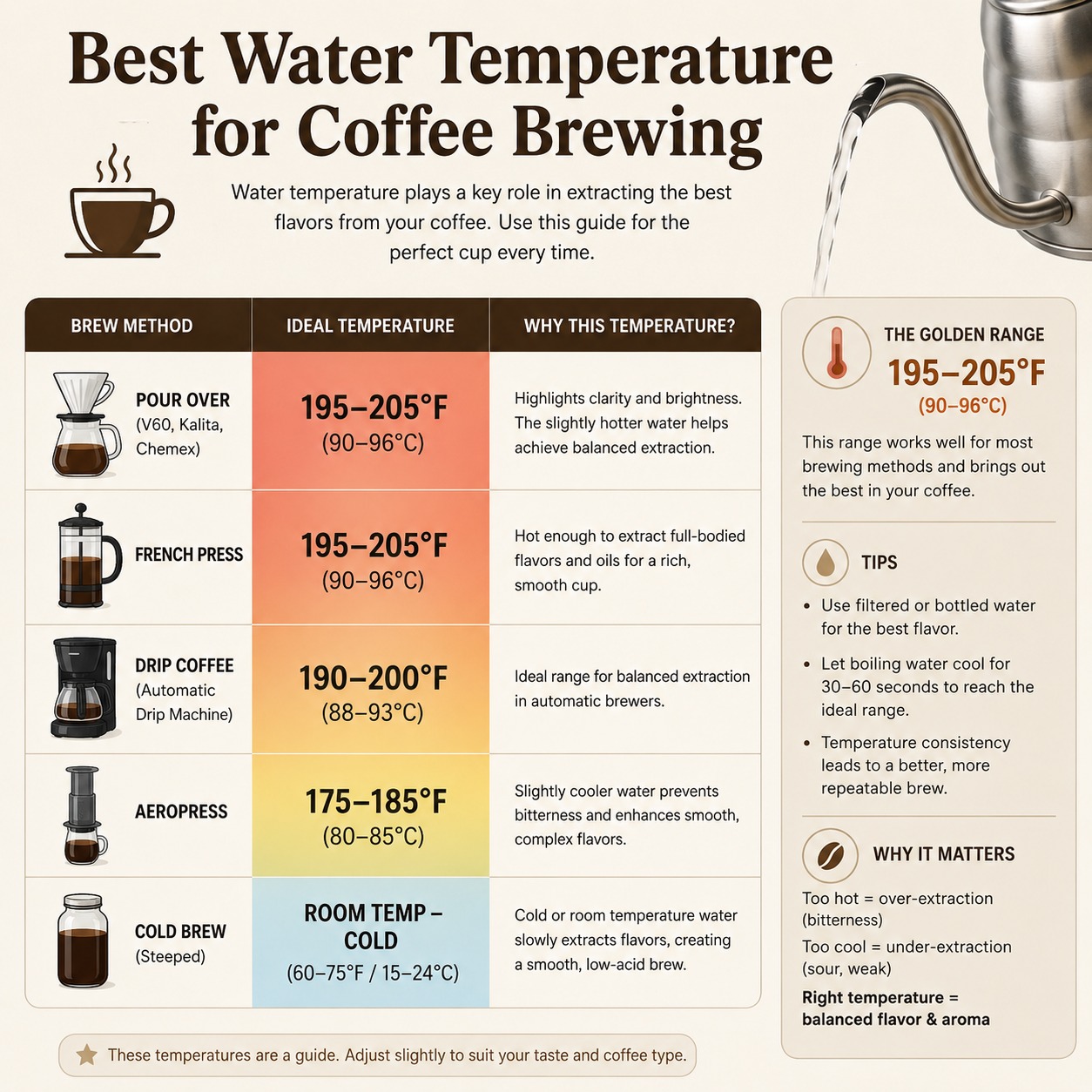
The best water temperature for coffee brewing is between 195°F and 205°F (90°C to 96°C), according to the Specialty Coffee Association (SCA). Water in this range extracts the right balance of flavors without burning the coffee grounds. Boiling water at 212°F (100°C) is too hot and pulls out bitter compounds. Cold water, on the other hand, under-extracts and leaves your coffee weak and sour.
Key Takeaways
- The SCA-recommended best water temperature for coffee brewing is 195°F to 205°F (90°C to 96°C).
- Water that is too hot causes over-extraction, making coffee bitter and harsh.
- Water that is too cold causes under-extraction, making coffee sour and flat.
- Espresso uses 190°F to 196°F (88°C to 91°C); pour-over uses 195°F to 205°F (90°C to 96°C).
- French press works best at 195°F to 200°F (90°C to 93°C).
- AeroPress allows more flexibility, from 175°F to 205°F (80°C to 96°C), depending on roast.
- Cold brew uses room temperature or cold water, around 35°F to 70°F (2°C to 21°C).
- Water temperature does not significantly change caffeine content in your cup.
- If you have no thermometer, let boiling water rest for 30 to 45 seconds to reach the right range.
- Lighter roasts generally need slightly hotter water; darker roasts do better with slightly cooler water.
What Is the Ideal Water Temperature for Brewing Coffee
The ideal water temperature for brewing coffee is 195°F to 205°F (90°C to 96°C). This range is backed by the Specialty Coffee Association and applies to most hot brewing methods. Within this window, water pulls out the sugars, acids, and aromatic compounds that make coffee taste balanced and full.
Going even a few degrees outside this range matters more than most people expect. At 185°F (85°C), coffee often tastes thin and sour. At 212°F (100°C), it turns sharp and bitter. The 10-degree window between 195°F and 205°F is where the best results consistently happen.
Why this range works:
- Sugars dissolve properly, giving sweetness and body.
- Acids extract at the right rate, adding brightness without sourness.
- Bitter compounds extract last, so staying under 205°F keeps them in check.
Why Does Water Temperature Matter for Coffee Taste
Water temperature controls which flavor compounds get pulled out of the coffee grounds, and in what order. This process is called extraction. Get the temperature right and you get a balanced cup. Get it wrong and one flavor group dominates.
Here is the basic order of extraction:
- Acids extract first (fruity, bright notes).
- Sugars extract next (sweetness, body).
- Bitter compounds extract last (harsh, dry finish).
Hotter water speeds up all three stages. If water is too hot, you rush past the sweet spot and pull too many bitter compounds. If it is too cool, you stop before the sugars fully extract, leaving a sour, weak cup.
This is why the best water temperature for coffee brewing is not just a preference. It is the difference between a cup that tastes right and one that tastes off.
How Does Temperature Affect Coffee Extraction
Temperature directly controls extraction rate and extraction yield. Higher temperatures speed up the chemical reactions that dissolve flavor compounds from the coffee grounds. Lower temperatures slow them down.
Extraction yield is the percentage of the coffee grounds that ends up dissolved in your cup. The SCA’s target for a well-extracted cup is roughly 18% to 22% extraction yield. Water that is too hot pushes yield above 22%, causing over-extraction. Water that is too cool keeps yield below 18%, causing under-extraction.
- Over-extracted coffee tastes bitter, dry, and astringent.
- Under-extracted coffee tastes sour, salty, and weak.
- Properly extracted coffee tastes balanced, sweet, and clean.
Temperature also interacts with grind size. If your water is slightly cooler, a finer grind can compensate by increasing surface area. If your water is slightly hotter, a coarser grind slows extraction down. These two variables work together, which is why changing one often means adjusting the other.
Best Water Temperature for Espresso vs Pour Over
These two methods use different temperatures because they work differently. Espresso pushes pressurized water through tightly packed grounds in 25 to 35 seconds. Pour over uses gravity and takes 3 to 4 minutes.
Espresso: 190°F to 196°F (88°C to 91°C)
- The pressure and fine grind extract very efficiently, so slightly cooler water prevents over-extraction.
- Most modern espresso machines are factory-set around 93°C (199°F), but experienced baristas often dial this down for darker roasts.
Pour over: 195°F to 205°F (90°C to 96°C)
- Longer contact time means you need hotter water to extract fully.
- Light roasts benefit from the higher end of this range (around 205°F).
If you use a pour-over grinder and want to dial in your brew, pairing the right grind size with the correct temperature makes a noticeable difference.
Can You Use Boiling Water for Coffee
Boiling water at 212°F (100°C) is too hot for most brewing methods. It over-extracts the coffee quickly, pulling out bitter and astringent compounds that overwhelm the other flavors. The result is a harsh, unpleasant cup.
There is one exception: the Moka pot. The Bialetti Moka Express and similar stovetop brewers work with near-boiling water because the pressurized steam extraction is very brief. Even then, many Moka pot users pre-heat water to just below boiling to avoid scorching the grounds.
Bottom line: Do not pour boiling water directly over coffee grounds for pour over, French press, or AeroPress. Let it cool first.
What Temperature Water for French Press
French press works best with water at 195°F to 200°F (90°C to 93°C). The immersion brewing method and coarser grind size mean a 4-minute steep, so you want water hot enough to extract fully but not so hot that it turns bitter over that time.
For the best French press results:
- Boil water, then let it sit for 30 to 45 seconds.
- Use a coarse grind to avoid over-extraction during the steep.
- Steep for 4 minutes, then press slowly.
Choosing the right grind matters as much as temperature. Check out our guide to coarse ground coffee for French press for grind size recommendations that pair well with this temperature range.
What Temperature Water for AeroPress Brewing
AeroPress is one of the most flexible brewers when it comes to water temperature. Most recipes work well between 175°F and 205°F (80°C to 96°C), depending on the roast and brew style.
- Light roasts: Use 200°F to 205°F (93°C to 96°C) for full extraction.
- Medium roasts: Use 185°F to 200°F (85°C to 93°C).
- Dark roasts: Use 175°F to 185°F (80°C to 85°C) to avoid bitterness.
- Inverted method: Slightly hotter water works well because steeping time is longer.
AeroPress rewards experimentation. If your cup tastes bitter, drop the temperature by 5 degrees. If it tastes sour or weak, raise it.
How to Measure Water Temperature Without a Thermometer
If you do not have a thermometer, the simplest method is the rest-after-boiling approach. Boil water, remove it from heat, and wait 30 to 45 seconds. This typically brings water from 212°F (100°C) down to around 200°F to 205°F (93°C to 96°C), which is right in the target range.
Visual cues also help:
- Rolling boil = 212°F (100°C). Too hot.
- Small bubbles rising steadily = around 190°F to 195°F (88°C to 90°C). Good for espresso.
- Steaming with no bubbles = around 160°F to 175°F (71°C to 79°C). Too cool for most methods.
For consistent results, a simple instant-read thermometer or a gooseneck kettle with a built-in temperature display is worth the investment. It removes guesswork entirely.
Does Water Temperature Affect Caffeine Content
Water temperature has a minor effect on caffeine extraction, but it does not meaningfully change the caffeine content in your finished cup. Caffeine is highly soluble and extracts quickly across a wide temperature range. Even at lower temperatures, most of the caffeine dissolves into the water.
The bigger factors affecting caffeine content are:
- Coffee-to-water ratio (more grounds = more caffeine).
- Grind size (finer grind = faster, more complete extraction).
- Brew time (longer contact = slightly more caffeine).
For a deeper look at how brewing variables affect caffeine, see our breakdown of caffeine in filter coffee.
Best Water Temperature for Cold Brew Coffee
Cold brew uses no heat at all. The best water temperature for cold brew is between 35°F and 70°F (2°C to 21°C), which covers both refrigerator cold brew and room-temperature cold brew.
- Refrigerator cold brew: Brewed at 35°F to 40°F (2°C to 4°C) for 18 to 24 hours.
- Room-temperature cold brew: Brewed at 65°F to 70°F (18°C to 21°C) for 12 to 16 hours.
The cold water extracts coffee very slowly, which is why steep times are so much longer. The result is a low-acid, naturally sweet concentrate. Grind size matters a lot here. A coarser grind prevents over-extraction during the long steep. See our picks for the best coffee grinders for cold brew to get the right grind for this method.
What Happens If Water Is Too Hot for Coffee
Water above 205°F (96°C) over-extracts coffee, pulling out bitter, harsh compounds that overpower the natural sweetness and acidity of the beans. The cup tastes dry, sharp, and unpleasant.
Specific effects of water that is too hot:
- Bitterness spikes because chlorogenic acids break down into quinic acid and other harsh compounds.
- Aroma is damaged because volatile aromatic compounds evaporate too quickly.
- Sweetness is buried under the bitter finish.
If your coffee consistently tastes bitter and you have not changed your beans or grind, check your water temperature first. It is the most common and most overlooked cause of bitter coffee.
Does Water Temperature Affect Coffee Bitterness
Yes, water temperature is one of the main drivers of coffee bitterness. Bitter compounds extract at higher temperatures and longer contact times. When water is too hot, those compounds extract faster and in greater volume.
To reduce bitterness:
- Lower your water temperature by 5°F to 10°F.
- Use a slightly coarser grind to slow extraction.
- Shorten brew time if possible.
To increase body and reduce sourness (under-extraction):
- Raise water temperature by 5°F.
- Use a slightly finer grind.
- Extend brew time slightly.
This is especially relevant when brewing darker roasts. Dark roasts already have more bitter compounds from the roasting process, so they benefit from slightly cooler water (around 195°F to 198°F / 90°C to 92°C).
Best Water Temperature for Different Coffee Beans
Roast level is the main factor that changes the ideal brewing temperature for different beans. Lighter roasts are denser and need more heat to extract fully. Darker roasts are more porous and extract faster, so they need less heat.
| Roast Level | Ideal Temperature (°F) | Ideal Temperature (°C) |
|---|---|---|
| Light Roast | 200°F to 205°F | 93°C to 96°C |
| Medium Roast | 195°F to 205°F | 90°C to 96°C |
| Medium-Dark Roast | 195°F to 200°F | 90°C to 93°C |
| Dark Roast | 190°F to 196°F | 88°C to 91°C |
If you are working with specialty single-origin beans, the origin can also play a role. High-altitude beans like Kenyan coffees tend to be denser and bright, so they often benefit from the higher end of the temperature range.
How Long to Let Boiling Water Cool Before Brewing
Let boiling water rest for 30 to 45 seconds off the heat to drop from 212°F (100°C) to roughly 200°F to 205°F (93°C to 96°C). This is the simplest no-thermometer method for most hot brewing methods.
Cooling time by target temperature (approximate):
- 30 seconds = around 205°F (96°C), good for light roast pour over.
- 45 seconds = around 200°F (93°C), good for medium roast, French press.
- 60 to 90 seconds = around 195°F (90°C), good for dark roast espresso or AeroPress.
These are estimates based on a standard kettle in a room at about 70°F (21°C). Thinner kettles cool faster; thicker ones retain heat longer. A temperature-controlled kettle removes all guesswork.
Conclusion
Getting the best water temperature for coffee brewing right is one of the easiest ways to improve your cup without buying new equipment or changing your beans. The SCA’s 195°F to 205°F (90°C to 96°C) range works for most brewing methods, but small adjustments by roast level and brew style make a real difference.
Your actionable next steps:
- If you do not own a thermometer, start with the 30 to 45 second rest method after boiling.
- If your coffee tastes bitter, drop your temperature by 5°F and see if it improves.
- If your coffee tastes sour or weak, raise your temperature by 5°F.
- Match your temperature to your roast: hotter for light, cooler for dark.
- For cold brew, skip the heat entirely and use cold or room-temperature water with a long steep.
For more brewing guides and equipment recommendations, visit the Advisor Coffee brewing guides hub to keep dialing in your technique.
Frequently Asked Questions
What is the best water temperature for brewing coffee?
The best water temperature for coffee brewing is 195°F to 205°F (90°C to 96°C). This range, recommended by the Specialty Coffee Association, extracts a balanced cup without over- or under-extracting flavor compounds.
Is 200 degrees good for coffee?
Yes. 200°F (93°C) sits right in the middle of the ideal range and works well for most brewing methods including pour over, French press, and drip coffee. It is a reliable default temperature.
Can I use boiling water for coffee?
Boiling water at 212°F (100°C) is too hot for most methods. It over-extracts bitter compounds and can damage delicate aromas. Let boiling water cool for 30 to 45 seconds before brewing.
What temperature is best for espresso?
Espresso brews best at 190°F to 196°F (88°C to 91°C). The high pressure and fine grind extract very efficiently, so slightly cooler water prevents a bitter, over-extracted shot.
Does water temperature affect how bitter coffee tastes?
Yes. Hotter water extracts bitter compounds faster and in larger amounts. If your coffee is consistently bitter, lowering your water temperature by 5°F to 10°F is often the quickest fix.
What temperature should I use for a French press?
Use water at 195°F to 200°F (90°C to 93°C) for French press. This accounts for the 4-minute steep time and coarser grind, giving full extraction without bitterness.
What water temperature works for cold brew?
Cold brew uses no heat. Brew at 35°F to 40°F (2°C to 4°C) in the refrigerator for 18 to 24 hours, or at room temperature (65°F to 70°F / 18°C to 21°C) for 12 to 16 hours.
How do I know when water is the right temperature without a thermometer?
Boil water, remove from heat, and wait 30 to 45 seconds. This brings the temperature to approximately 200°F to 205°F (93°C to 96°C), which is within the ideal brewing range for most methods.
Does water temperature change caffeine levels?
Not significantly. Caffeine dissolves easily across a wide temperature range. The amount of caffeine in your cup is much more affected by your coffee-to-water ratio and grind size than by temperature.
What temperature is best for light roast coffee?
Light roast beans are denser and need more heat to extract fully. Use water at 200°F to 205°F (93°C to 96°C) for light roast coffee to get the full flavor.
What temperature is best for dark roast coffee?
Dark roast beans are more porous and extract quickly. Use slightly cooler water at 190°F to 196°F (88°C to 91°C) to avoid pulling out too many bitter compounds.
Does AeroPress need a specific water temperature?
AeroPress is flexible. Use 175°F to 185°F (80°C to 85°C) for dark roasts, 185°F to 200°F (85°C to 93°C) for medium roasts, and 200°F to 205°F (93°C to 96°C) for light roasts.
References
- Specialty Coffee Association. Water Quality Standards for Coffee Brewing. SCA, 2017. https://sca.coffee
- Rao, Scott. The Coffee Roaster’s Companion. Scott Rao, 2014.
- Yerlan Abenov et al. “Effect of Brewing Temperature on Coffee Extraction.” Food Chemistry, 2019.