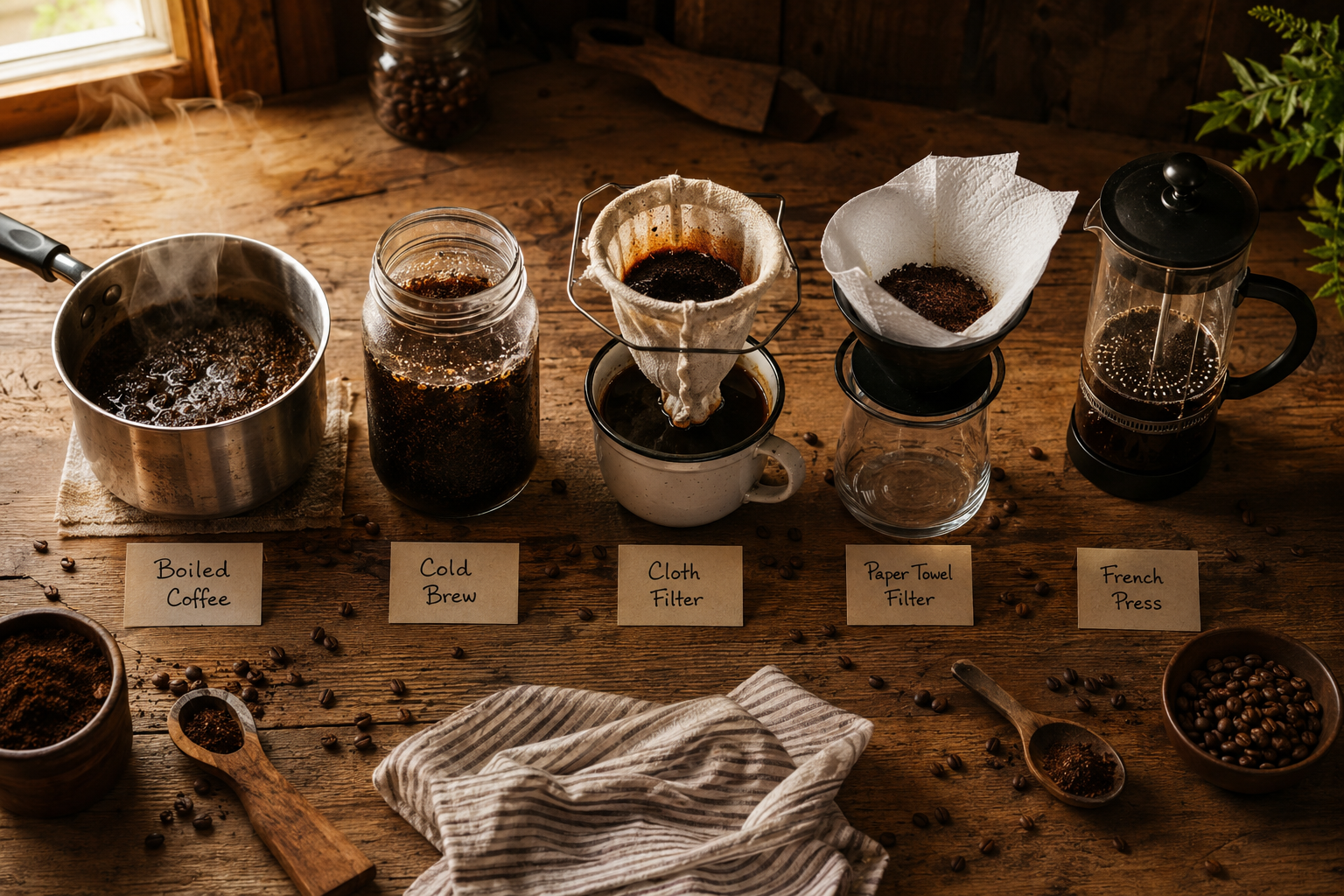
You can make coffee without a coffee maker using hot water and ground coffee. The easiest methods are the cowboy method (boiling grounds in a pot), the makeshift pour-over (using a cloth or paper towel as a filter), and cold brew in a jar. Each takes 5 to 15 minutes and uses tools you already have at home.
Key Takeaways
- You need two things to brew coffee manually: hot water (around 195-205°F) and ground coffee
- The standard ratio is 1 to 2 tablespoons of ground coffee per 6 ounces of water
- A cloth, paper towel, or fine-mesh strainer can replace a coffee filter
- Boiling coffee directly in a pot is safe, but it can make the coffee taste bitter if overcooked
- Cold brew requires no heat at all, just coarse grounds, cold water, and 12 to 24 hours
- A paper towel works as a filter in a pinch, but it can tear and slow down the drip
- You cannot make true espresso without a machine, but a stovetop Moka pot comes close
- The cheapest way to make coffee at home manually is the cowboy method, just a pot and water
- Coarse grounds work best for most no-equipment methods and reduce sediment in your cup
- Letting grounds settle before pouring is the simplest way to avoid grit in your drink
What Are the Different Methods to Make Coffee Without a Coffee Maker
There are six reliable ways to make coffee without a coffee maker, and each one uses basic kitchen tools. The best method depends on what you have on hand and how much time you want to spend.
Here is a breakdown of all six methods:
| Method | Equipment Needed | Time | Difficulty |
|---|---|---|---|
| Cowboy Coffee (pot boil) | Saucepan, water | 10 min | Easy |
| Makeshift Pour-Over | Mug, cloth or paper towel | 8 min | Easy |
| Cold Brew in a Jar | Mason jar, strainer | 12-24 hrs | Very Easy |
| Bag Method | Coffee, bag or cloth | 5 min | Easy |
| Microwave Method | Mug, microwave | 5 min | Easy |
| Moka Pot (stovetop) | Moka pot, stove | 10 min | Moderate |
Each method produces a drinkable cup of coffee. The taste varies by method, but all of them work when you are without a machine.
How to Make Coffee With Just Hot Water and Ground Coffee
You only need two things: hot water and ground coffee. Heat water to just below boiling (around 195-205°F), add 1 to 2 tablespoons of ground coffee per 6 ounces of water, and let it steep before straining.
Step-by-step for the bag method:
- Measure 2 tablespoons of ground coffee into a small cloth bag, clean sock, or tied cheesecloth
- Heat 6 ounces of water in a saucepan until it just starts to steam (do not let it boil hard)
- Place the bag into a mug
- Pour hot water over the bag slowly
- Let it steep for 4 minutes
- Remove the bag and drink
This is the simplest version of how to make coffee without a coffee maker. It mimics a tea bag and keeps grounds out of your cup.
Can You Make Coffee in a Regular Pot on the Stove
Yes, you can make coffee in a regular pot on the stove. This is called cowboy coffee, and it is one of the oldest brewing methods around. Add water to a small saucepan, bring it to a near-boil, stir in ground coffee, let it sit for a few minutes, then pour slowly so the grounds stay at the bottom.
How to make cowboy coffee:
- Pour 6 to 8 ounces of water into a small saucepan
- Heat over medium until just about to boil
- Remove from heat and add 2 tablespoons of coarse ground coffee
- Stir once, then let it sit for 4 minutes
- Pour slowly into your mug, leaving the last bit of liquid (where grounds settle) in the pot
Common mistake: Do not keep boiling the coffee after adding grounds. Boiling for too long pulls out bitter compounds and makes the cup harsh. Remove from heat first, then add the grounds.
For best results with this method, use coarse ground coffee, it settles faster and leaves less sediment in your cup.
How Long Does It Take to Make Coffee Without a Coffee Maker
Most hot methods take 5 to 10 minutes from start to finish. Cold brew is the exception, it takes 12 to 24 hours but requires almost no active effort.
- Cowboy pot method: about 10 minutes
- Makeshift pour-over: about 8 minutes
- Bag/steep method: about 5 to 6 minutes
- Cold brew: 12 to 24 hours (hands-off)
- Microwave method: about 5 minutes
If you are in a hurry, the microwave method is fastest. Add water and grounds to a mug, microwave for 1 to 2 minutes, let the grounds settle for 2 minutes, then sip carefully from the top.
What Is the Best Way to Strain Coffee Grounds Without a Filter
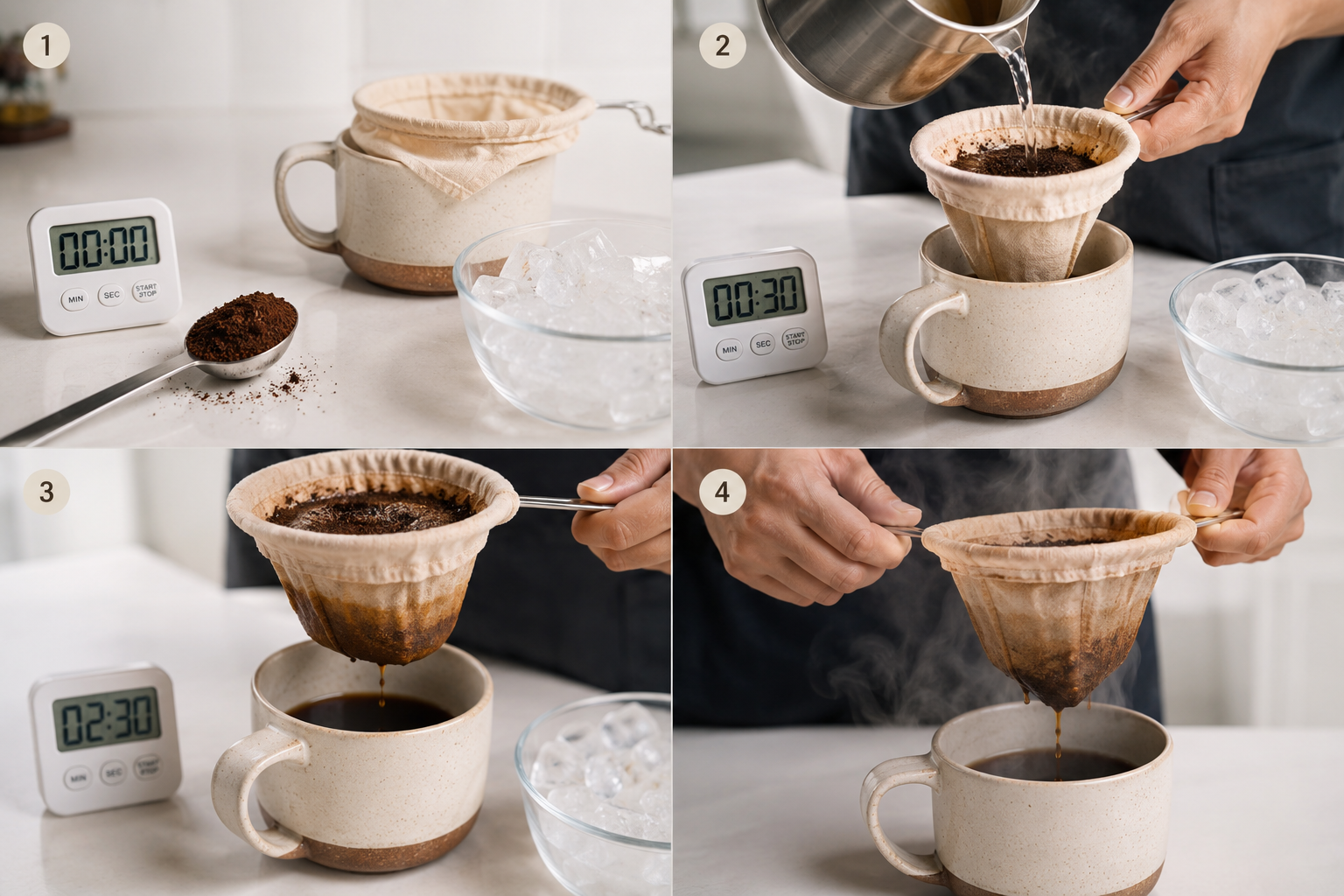
The best improvised strainer is a piece of tightly woven cloth, like a clean cotton t-shirt, dish towel, or cheesecloth. These materials let liquid through while catching fine grounds. A fine-mesh kitchen strainer also works well for larger particles.
Ranked from best to worst for straining:
- Clean cotton cloth or dish towel (best, catches fine grounds)
- Fine-mesh kitchen strainer (good, may let very fine grounds through)
- Paper towel in a funnel or mug (works, can tear or clog)
- Coffee sock or cheesecloth (great if you have one)
- Letting grounds settle and pouring carefully (no equipment needed)
For a cleaner cup long-term, check out quality paper coffee filters that you can keep on hand for pour-over brewing.
Can You Use a Paper Towel as a Coffee Filter
Yes, a paper towel can work as a coffee filter in an emergency. Fold it into a cone shape, place it over your mug, add ground coffee, and pour hot water slowly over the grounds. The paper towel will drip coffee through into your cup below.
Downsides to know:
- Paper towels can tear if you pour too fast or use too much water
- Some paper towels have a slight chemical taste, rinse with hot water first
- They drip slower than real filters, so expect a longer wait
- Very fine grounds may still pass through
This method works, but it is not ideal for daily use. If you find yourself needing it often, it may be worth picking up a proper filter or a reusable cloth option.
How to Make Cold Brew Coffee Without Equipment
Cold brew is the easiest no-equipment method. Add coarse ground coffee to a jar or pitcher, pour cold water over it, stir, cover, and leave it in the fridge for 12 to 24 hours. Then strain through a cloth or fine strainer and drink.
Cold brew ratio: Use 1 cup of coarse ground coffee to 4 cups of cold water for a concentrate. Dilute with water or milk before drinking.
Steps:
- Add 1 cup of coarse ground coffee to a clean mason jar or pitcher
- Pour in 4 cups of cold, filtered water
- Stir to make sure all grounds are wet
- Cover loosely and refrigerate for 12 to 24 hours
- Strain through a cloth or fine strainer into another container
- Store in the fridge for up to 2 weeks
Cold brew made this way is smooth, low-acid, and strong. For the best results, use a quality coarse ground coffee designed for this style of brewing.
Does Making Coffee in a Pot Taste as Good as a Coffee Maker
It depends on the method and your technique. Cowboy coffee and makeshift pour-overs can taste very close to drip coffee when done correctly. The main difference is consistency, a coffee maker controls temperature and flow rate automatically, while manual methods require more attention.
What affects taste most:
- Water temperature: Too hot (full boil) makes coffee bitter. Aim for 195-205°F.
- Steep time: Too long = bitter. Too short = weak. Four minutes is a solid baseline.
- Coffee-to-water ratio: 1 to 2 tablespoons per 6 ounces is the standard starting point
- Grind size: Coarser grinds work better for most manual methods
If you use good coffee beans and pay attention to temperature and timing, the result is genuinely good. Many coffee fans prefer the hands-on control of manual brewing over an automatic machine.
What Household Items Can I Use to Filter Coffee
Several common household items work as coffee filters. The key is finding something porous enough to let liquid through but dense enough to catch grounds.
Items that work:
- Clean cotton cloth or dish towel
- Cheesecloth
- Paper towels (folded into a cone)
- Fine-mesh kitchen strainer or sieve
- Clean bandana or cotton handkerchief
- Nut milk bag (if you have one)
- Clean cotton sock (yes, really, use a new one)
Items that do not work well:
- Loose-weave fabrics (grounds pass through)
- Synthetic fabrics (can affect taste)
- Thick terry cloth towels (too dense, drips too slowly)
How Much Coffee Grounds Do I Need Without a Coffee Maker
The standard ratio is 1 to 2 tablespoons of ground coffee per 6 ounces of water. For a stronger cup, use 2 tablespoons. For a lighter cup, use 1 tablespoon. This ratio applies to most manual brewing methods.
For cold brew, the ratio changes. Use about 1 cup of coffee grounds to 4 cups of water because cold water extracts more slowly and you will dilute the concentrate before drinking.
For more detail on exact measurements, see this guide on how many coffee beans per cup to dial in your ratios.
Can You Make Espresso Without an Espresso Machine
You cannot make true espresso without an espresso machine because espresso requires 9 bars of pressure that only a machine can produce. However, a stovetop Moka pot comes close, it produces a strong, concentrated coffee that tastes similar to espresso.
How a Moka pot works:
- Water in the bottom chamber heats up and creates steam pressure
- That pressure pushes hot water up through packed coffee grounds
- The result is a thick, strong coffee concentrate
The Bialetti Moka Express is the most popular option and costs around $30 to $40. It is the closest thing to espresso you can make on a stove.
For more no-machine espresso options, see this full breakdown on how to make espresso without a machine at home.
What Is the Cheapest Way to Make Coffee at Home
The cheapest way to make coffee at home is the cowboy method, all you need is a saucepan, water, and ground coffee. There is no equipment to buy. If you already have a pot and a bag of coffee, the cost is zero beyond the coffee itself.
Cost comparison for no-equipment methods:
- Cowboy coffee: $0 extra (just coffee + pot you own)
- Paper towel filter: pennies per cup
- Cold brew in a jar: $0 if you have a jar at home
- Moka pot: one-time cost of $25 to $40, then just coffee
If you want to step up without spending much, a basic manual pour-over setup or a Moka pot are both affordable long-term investments.
How to Avoid Getting Grounds in Your Cup When Making Coffee Manually
The most reliable way to avoid grounds in your cup is to use a cloth strainer or let the grounds fully settle before pouring. Coarser grounds settle faster and are easier to separate from the liquid.
Tips to reduce sediment:
- Use coarse ground coffee, fine grounds float and pass through most filters
- Let the coffee sit for 2 to 3 minutes after brewing before pouring
- Pour slowly and stop before you reach the last half-inch of liquid in the pot
- Double-strain through two layers of cloth for the cleanest cup
- Use a fine-mesh strainer as a second pass after your main filter
Is it safe to boil coffee grounds directly in water? Yes, it is completely safe. Boiling coffee grounds in water is how cowboy coffee has been made for centuries. The only risk is taste, boiling too long or at too high a temperature pulls out harsh, bitter compounds. Keep it at a near-boil (not a rolling boil) and limit steep time to 4 minutes for the best result.
Conclusion
Knowing how to make coffee without a coffee maker is a practical skill that every coffee drinker should have. Whether your machine breaks, you are camping, or you just want to try something new, these methods work.
Your next steps:
- Try the cowboy method first, it requires nothing extra and takes 10 minutes
- If you want a cleaner cup, grab a piece of cotton cloth and try the makeshift pour-over
- For a smooth, low-effort option, start a cold brew tonight and have it ready tomorrow morning
- If you want espresso-style strength, a Moka pot is worth the small investment
The best method is the one that fits what you have right now. Start simple, adjust your ratio and steep time based on taste, and you will have a solid cup every time, no machine required.
Frequently Asked Questions
Can I make coffee without a filter of any kind?
Yes. The cowboy method requires no filter at all. You add grounds to hot water, let them settle to the bottom of the pot, and pour carefully. Some grounds will end up in your cup, but most settle if you wait 3 to 4 minutes before pouring.
What grind size is best for making coffee without a machine?
Coarse ground coffee works best for most manual methods. It settles faster, is easier to strain, and produces less sediment. Fine grinds are harder to filter and can make your coffee taste bitter if they over-steep.
Can I use instant coffee instead of ground coffee?
Yes. Instant coffee dissolves completely in hot water and requires no brewing or filtering. It is the fastest no-equipment option, though the flavor is different from freshly brewed ground coffee.
How do I know when the water is the right temperature without a thermometer?
Remove the water from heat just as it starts to steam and small bubbles form on the bottom of the pot. That is roughly 195-205°F. A full rolling boil is too hot and will make the coffee taste bitter.
Can I make coffee in a microwave?
Yes. Add 2 tablespoons of ground coffee to a mug, pour in 6 ounces of cold water, and microwave for 1 to 2 minutes. Let it sit for 2 minutes so grounds settle, then sip carefully from the top without disturbing the bottom.
How long does cold brew last in the fridge?
Cold brew concentrate keeps well in a sealed container in the fridge for up to 2 weeks. Once diluted with water or milk, drink it within 2 to 3 days.
Does the type of coffee bean matter for manual brewing?
Yes, but not drastically. A medium roast is forgiving and works well across all manual methods. Dark roasts can turn bitter if over-steeped. Light roasts need slightly longer steep times to extract fully.
Is cowboy coffee bad for you?
No, cowboy coffee is not harmful. Unfiltered coffee does contain more cafestol, a compound that can raise LDL cholesterol with very frequent consumption. If you drink it occasionally, there is no meaningful health concern.
What is the easiest manual coffee method for beginners?
The bag method or the microwave method are the easiest starting points. Both require minimal technique and produce a decent cup with very little that can go wrong.
Can I reuse coffee grounds for a second brew?
You can, but the second cup will be noticeably weaker and more watery. Most of the flavor compounds extract in the first brew. If you want a second cup, it is better to use fresh grounds.
References
- National Coffee Association. (2020). How to Brew Coffee. https://www.ncausa.org/About-Coffee/How-to-Brew-Coffee
- Specialty Coffee Association. (2018). Water for Brewing Standards. https://sca.coffee/research/water-for-brewing-standards
- Healthline. (2020). Cafestol and Kahweol: The Cholesterol-Raising Compounds in Coffee. https://www.healthline.com/nutrition/coffee-worlds-biggest-source-of-antioxidants